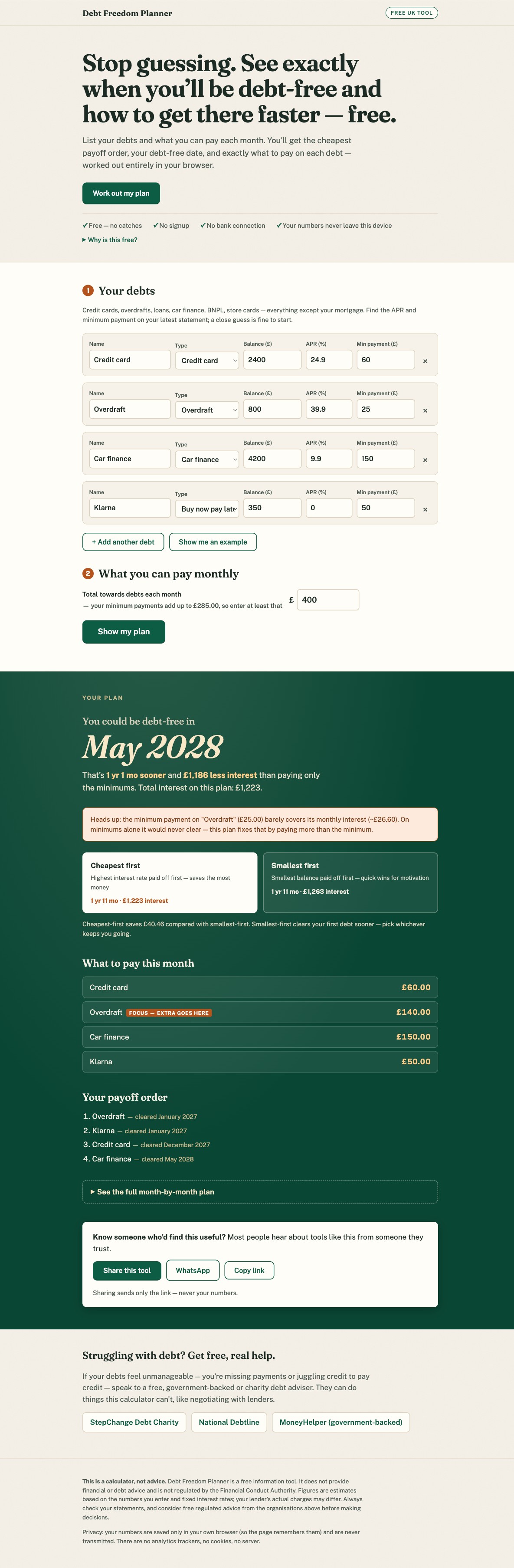
An empty folder at 10:23. A shipped, validated product by the afternoon.
The story of Debt Freedom Planner — a free UK debt payoff calculator where every product, design, and marketing decision was made with simulated-audience data. Four studies · 804 simulated UK adults · 15 evidence-backed decisions.
The brief
Ship a personal finance product for UK consumers. Win 100 users.
No concept given. No spec. One tool that changes everything: Semilattice — simulated UK audiences accurate enough (90% benchmarked) to do discovery, concept testing, copy testing, and usability research in minutes instead of weeks.
4
Semilattice studies, each feeding the next
804
simulated UK adults (Consumer Finance audience)
~4 min
per study, concept to data
Study 1 · Discovery — "what hurts most?" · view study ↗
Budgeting hurts 5× more than anything else…
"Which personal finance task frustrates you most?"
Budgeting & tracking money46.6%
Paying off debts efficiently10.0%
Tax6.6%
Savings goals3.3%
Pensions2.4%
Study 1 · Discovery — "why do current apps fail?" · view study ↗
…and people don’t want another dashboard. They want to be told what to do.
Biggest frustration with money apps people have tried
"No useful advice — just data"39.7%
Require linking my bank15.8%
Too much manual data entry14.1%
Don't trust them with my info8.3%
→ Decisions D1–D3: give specific actions, never just charts · no bank connection (93.8% prefer it) · data never leaves the device (85.5% abandon over data sharing).
minor issues found → fixed and re-shipped the same day (v1.1)
"The overdraft warning felt like the tool was actually looking out for me." — the never-clears interest warning was the standout trust moment, cited by 4 of 5 users.
The method, made visible
Four studies. Fifteen decisions. No decision without a number.
Every decision cites the exact data point that produced it, every study inherits the decisions before it, and superseded choices are struck through — never deleted. The whole lineage is an interactive graph.
S1→S4
each study consumed the last one's decisions as fixed context
52.4% decide whether to try a money tool based on trusting the source, and 84.3% pass useful tools to friends. So: no ads — launch posts drafted for the UK's trusted money communities (Reddit personal-finance subs, the MoneySavingExpert forum, Show HN), and the share loop is built into the results screen.
52.4%
decide on source trust → trusted communities, not ads
84.3%
would send the link to a friend → sharing is the growth engine
100
users = success, measured by GitHub Pages traffic (no tracking on-site, by design)